How can I stand out?
How can you stand out in a job interview? Perhaps the answer isn’t in presenting yourself differently, but in becoming someone whose character naturally shines through.

Shima Yoshida
Founding Editor

For a few minutes, I want you to imagine the situation that I’m about to describe. You are at a job interview. It’s for the job you really want. You are waiting for your name to be called and to enter the room where a group of strangers is waiting to scrutinize you — to decide whether you are the person they are looking for. A person just passed by you who seems to have finished her interview, smiling and with complete confidence on her face. You feel your stomach tighten into a knot.
I assume you’ve experienced a similar situation before.
When I go to a job interview, I find myself hoping that they will see my character, not just ask about my skills. For many years, I’ve been searching for a way to answer common interview questions that truly convey my personality. Even now that I am approaching retirement age, I still haven’t quite gotten the trick.
However, I’ve been blessed by people with an incredible ability to see a person’s character in a short amount of time, even when I didn’t present myself very well. Through them, I’ve been given opportunities to work with some truly wonderful people.
There are people who can convey their character to others quickly during an interview. They have my admiration and respect! I’ve always wanted to be that kind of person. I’ve lived my life long enough to strive to become someone whose character shines through, but I feel I still have a long way to go.
The character traits I hope others will see in me are honesty, integrity, and virtue. These are attributes that I honor and believe I have inherited from Heavenly Father and Jesus Christ. But these qualities aren’t something we put on for a show. They radiate from us. So, if people don’t see these qualities in me, I have to look at myself. Perhaps I wasn’t sufficiently tuned in to the Spirit that can help those qualities shine.
This summer, my family and I visited Carthage Jail in Illinois. It is the place where Joseph Smith, the first prophet of The Church of Jesus Christ of Latter-day Saints, was imprisoned and martyred during a mob attack.
A senior missionary couple led our tour. The missionary explained the conditions surrounding Joseph’s imprisonment and shared an interesting fact about jail in the 1840s. It was common for jailers to live in the jail building with their families. George W. Stigall, the jailer at the time, lived there with his wife and children.
Stigall appeared to be sympathetic toward Joseph Smith and his companions. Contemporary accounts describe him and his wife treating the prisoners hospitably. Because the first-floor debtor’s cell was dangerous and exposed, Stigal moved Joseph and others upstairs to the family bedroom.
The elder missionary explained that Stigall saw Joseph Smith’s character. People were drawn to him because of the goodness he radiated. In the Church, we might call it the light of Christ.
Then I found myself wondering: How did Joseph develop those qualities?
I found the answer at the Liberty Jail in Missouri. There, Joseph was imprisoned in a small square room with four-foot-thick walls from December 1838 to April 1839.
The hardest trial for Joseph was knowing that his family and friends were enduring persecution while he was powerless to stop it. Joseph pleaded with God for the deliverance of the Saints. The answer he received was, “My son, peace be unto thy soul; thine adversity and thine afflictions shall be but a small moment.”
For a long time, I struggled to understand God’s intention for Joseph. I simply tried to accept that this was how faith worked, even though I didn’t understand why. But an experience I had on the trip helped me understand what God meant by “peace.”
My family and I were traveling to Chicago to watch a Chicago White Sox game. During Friday evening rush hour, our car suddenly started blowing hot air, and the temperature gauge rose rapidly. We realized that our car had overheated.
We found an auto repair shop just before closing time. The owner asked us to leave the car so they could make sure there were no problems other than overheating. We agreed and rented another car so we could return to Rockford to attend our daughter’s baseball tournament the next day.
On Saturday night, we picked up our car after our daughter’s final game before the shop closed. The owner told us it was ready to go. We thanked him and hurried to O’Hare Airport to return our rental car.
Before leaving for our next destination, my husband checked the coolant, just to make sure everything looked good. We discovered that the coolant reservoir was empty.
We were confused. Just half an hour earlier, we had been told the car was safe to drive. But we concluded that it was not safe to drive.
Suddenly, we were stuck in the airport parking lot on Saturday night. No repair shops were open. We were in an unfamiliar city, with no one to rely on or trust.
We gathered together and prayed to God.
We wanted a miracle. We believe that God had the power to make one happen. But things didn’t go as we expected. And we were stranded at the airport for two nights.
One thing that we appreciated, however, was the peace we felt in our minds.
Under those circumstances, we could easily have fallen into blaming one another for what we did or didn’t do. Unwanted words could have slipped from our mouths, making an already difficult situation much worse. We could even have been tempted to blame God for not saving us from our troubles.
But we didn’t give in to those temptations. What we were really fighting was our human tendency to justify ourselves.
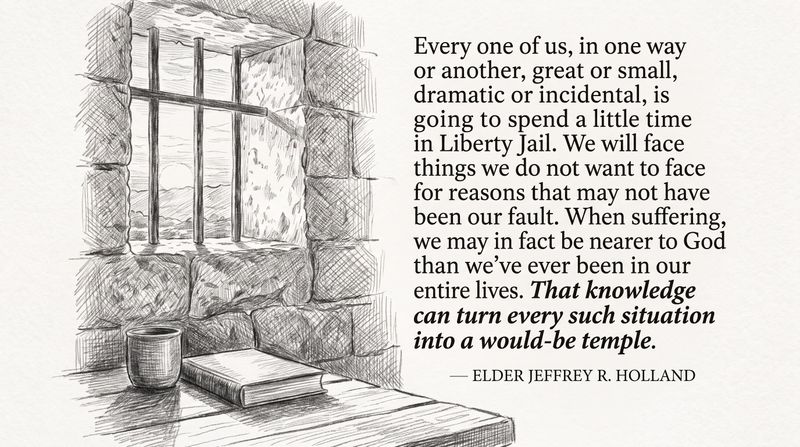
Later, at Liberty Jail, we heard Joseph’s prayer and God’s reply in an audio recording. What God meant by “peace” in that tremendous and dire situation finally hit me and washed my doubt away.
Joseph had not been spared from hardship. He had been placed in circumstances he did not choose and could not control. Yet somehow, he learned to maintain his faith and peace in the middle of them.
Perhaps that is how character is developed. That character became a beacon of the light of Christ, which attracted people like George W. Stigall to him at Carthage Jail.
Joseph’s virtue and integrity were not qualities he simply displayed when life was going well. They were formed through hardship, tested in moments when he had every reason to despair, and revealed in the way he responded.
The car trouble and my historical trip had become connected. Both helped me understand God’s purpose for our lives and His desire to guide us toward becoming more like Him. Sometimes, the circumstances we would never choose can become the very places where our character is formed.
After the trip, my hope is to become the kind of person whose character can radiate outward and remind others of God. I hope my words and actions will reflect the honesty, integrity, and virtue He has given to all of us.
And perhaps that is one of the best ways I can differentiate myself as a job applicant — not by trying to appear different, but by becoming the kind of person whose character naturally shows through wherever I go, even in a job interview.